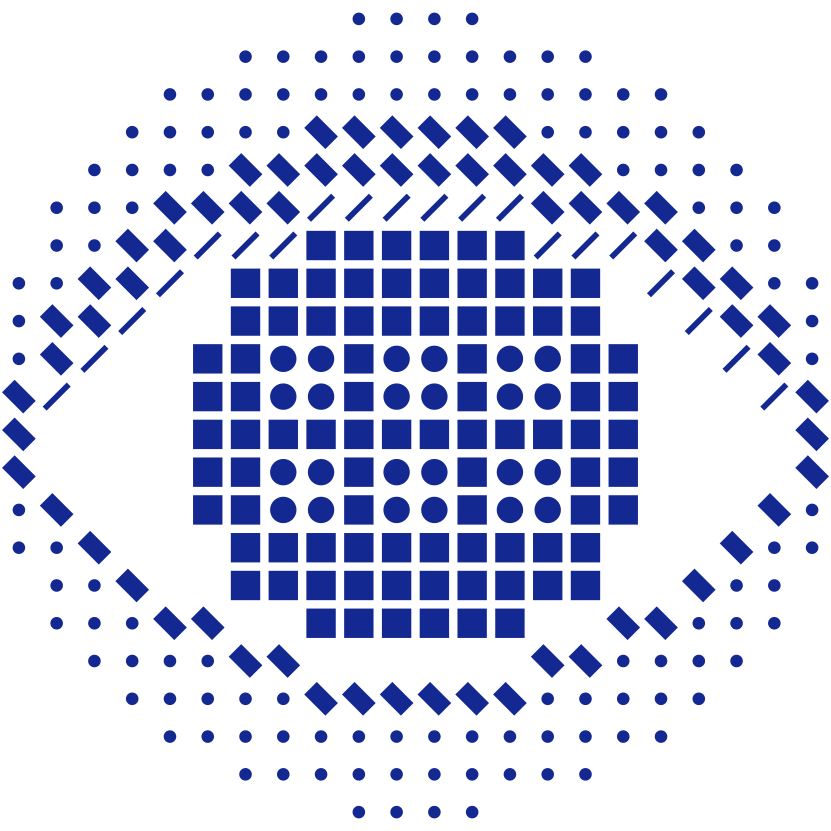
Wood Wide Web
2023
Prints, augmented reality
Béatrice Lartigue - Lab212
Since the earliest human civilizations, societies have maintained a relationship of dependence and respect toward the cycles of living systems.
Trees, for their part, developed their own communication networks long before the connected era: beneath the forest floor, a microscopic web of fungi links plant roots together. This mycorrhizal network — which scientists call the Wood Wide Web — circulates nutrients and chemical signals between species, ensuring the survival and cooperation of the system as a whole.
The title of the work draws a parallel between this biological reality and the World Wide Web: two interconnection infrastructures, one organic, one digital, operating on the same logics of flow, nodes and interdependence.
Wood Wide Web examines the ways in which our digital networks impact and destabilize the physical ecosystems on which we depend.
Visitors interact with a generative space whose forms unfold according to algorithms inspired by the growth patterns of living organisms, placing in tension the precision of computational systems and the plasticity of natural life.
The project draws on a purpose-built data corpus.
House of Digital Art, Port-Louis, MAU
Imane Lehérissier
Anais Dercy
related